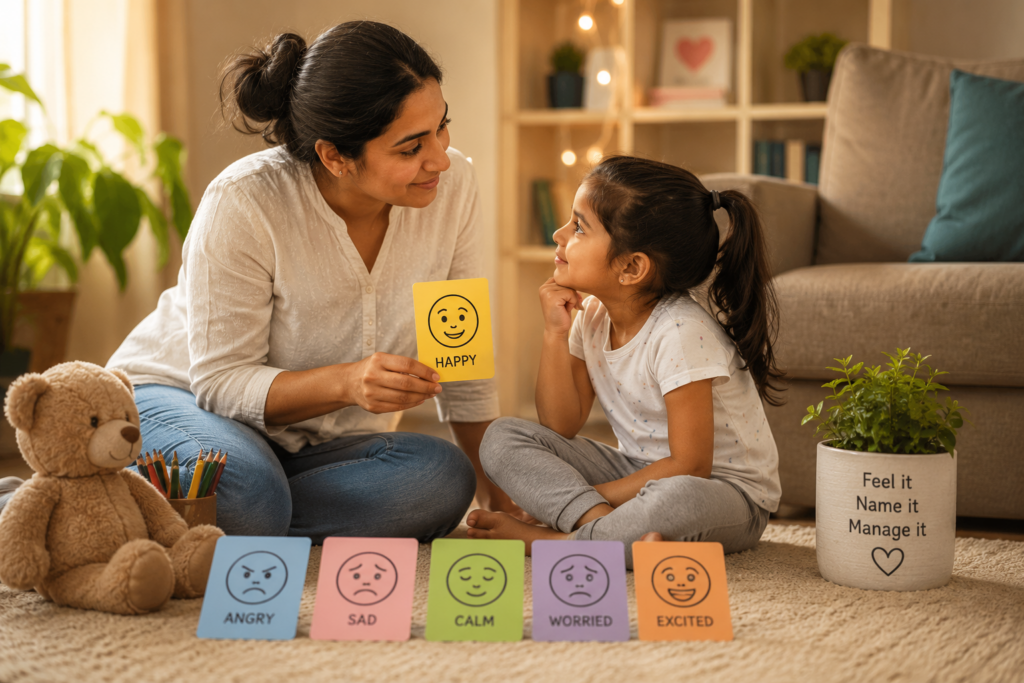
From the time she was a toddler, Aisha was the kind of child who lit up a room. She laughed easily, made friends everywhere she went, and had an energy that was genuinely infectious.

But when she started school, something shifted.

The world got bigger. The rules got more complicated. There were misunderstandings with friends, moments when she did not get what she wanted, days when things simply did not go her way. And Aisha, who had always expressed herself so freely, began to struggle. She would cry without being able to say why. She would lash out at her younger brother over something small. She would come home from school looking wrung out — emotionally depleted in a way that a six-year-old should not have to be.

Her mother Meera watched all of this carefully. She had always believed in mindfulness — in the importance of being present, of feeling things fully rather than pushing them away. And she began to understand that what Aisha needed was not to be calmed down or distracted or told to stop overreacting.

What she needed was to learn how to understand herself.

So Meera began, quietly and consistently, to teach Aisha the language of emotions. Not in big, formal lessons — but in small moments. At the dinner table. On the drive to school. At bedtime, when the day's feelings had settled into something that could be named.

"It sounds like you were feeling left out today. Is that right?"

"When you pushed your brother, I think you were feeling really frustrated. Can you tell me more about that?"

"I notice you seem sad right now. Do you know what's making you feel that way?"

Over months, something remarkable happened. Aisha began to answer those questions. Then she began to ask them of herself — without being prompted. And eventually, she began to manage her emotions in ways that genuinely surprised the adults around her.

At eight years old, she told a friend who had hurt her feelings: "When you said that, I felt really sad. I don't think you meant to hurt me, but I wanted you to know."

Meera cried when she heard about it. Not because it was perfect — but because it was real. Her daughter had learned to feel her feelings, name them, and speak them with both honesty and compassion.

That is what fostering emotional intelligence in kids actually looks like. Not a child who never cries. Not a child who is always calm. But a child who understands their inner world well enough to navigate it — and to navigate the world of other people with genuine empathy and grace.

What Is Emotional Intelligence and Why Does It Matter?

Emotional intelligence — sometimes called EQ — is the ability to recognise, understand, manage, and express emotions effectively, both in ourselves and in our relationships with others. It was first formally described by psychologists Peter Salovey and John Mayer, and later popularised by Daniel Goleman, who argued that EQ is often a more reliable predictor of life success than IQ.

The research since then has been consistent and compelling. Children with high emotional intelligence perform better academically, form stronger friendships, cope more effectively with stress, and grow into adults who are better equipped for leadership, relationships, and overall well-being.

And here is the most important thing: emotional intelligence is not a fixed trait. It is a skill — and like all skills, it can be learned, practised, and developed. The home is where that development begins, and mindful parents are its most powerful teachers.
 15 Mindful Parenting Tips for Fostering Emotional Intelligence in Kids
 Model Emotional Awareness Openly

Children learn the language of emotions by hearing it spoken. If emotions are never named in your household — if feelings are pushed down, dismissed, or treated as inconvenient — your child will grow up without the vocabulary to understand their own inner life.

Be deliberate about naming your own emotions out loud. "I am feeling a little overwhelmed right now, so I am going to take a few minutes to breathe." "I felt really proud of you today — did you notice?" "That conversation made me sad, and I am still thinking about it." These small disclosures show your child that emotions are normal, nameable, and manageable — not shameful or dangerous.

 Help Children Name What They Are Feeling

One of the most foundational skills in emotional intelligence is emotional granularity — the ability to distinguish between different emotional states rather than simply feeling "bad" or "good."

When your child is upset, resist the urge to immediately solve or soothe. Instead, slow down and help them identify what they are actually feeling. "Are you feeling angry, or is it more like frustration? Are you sad, or is it more like disappointed?" Use an emotion wheel if that helps — a visual chart that shows the full range of human emotions, from the basic to the nuanced. The richer your child's emotional vocabulary, the better equipped they are to understand and communicate their inner experience.

Validate Feelings Before Offering Solutions

This is perhaps the most important shift a parent can make — and one of the hardest. When our children are distressed, our instinct is to fix it. To offer a solution, a distraction, a reassurance. But what children need first — before any of that — is to feel heard.

"I can see you are really upset right now. That makes sense." "It sounds like today was really hard. Of course you feel that way." These simple validations do something profound — they tell a child that their feelings are real, that they are not too much, and that you are not afraid of them. From that foundation of feeling heard, a child becomes genuinely able to move through their emotion rather than being stuck in it.

 Teach Emotional Regulation Techniques

Understanding emotions is the first step. Managing them is the next — and it requires specific, practised techniques that children can reach for when they feel overwhelmed.

Teach belly breathing together — the kind where the stomach rises on the inhale and falls on the exhale. Practise counting slowly to ten before responding to something frustrating. Create a "calm-down kit" — a small box with a stress ball, a favourite photo, a piece of soft fabric — that your child can use when emotions feel too big. These tools are most effective when they are introduced and practised during calm moments, so that they are familiar and accessible when the storm arrives.
Cultivate Empathy Through Daily Conversation

Empathy — the ability to understand and share the feelings of another — is the social cornerstone of emotional intelligence. And it is built, primarily, through the habit of perspective-taking.

Make perspective-taking a regular part of your family's conversation. After a conflict with a sibling: "How do you think your brother felt when that happened?" After a story or a film: "What do you think that character was feeling in that moment? Why?" After a difficult interaction at school: "What do you think was going on for your friend that made them act that way?" These questions build the neural habit of considering other people's inner worlds — and that habit, practised consistently, becomes empathy.

Create a Home Where All Emotions Are Welcome

Children learn very quickly which emotions are acceptable and which are not. When tears are met with "stop crying," when anger is met with "go to your room," when fear is met with "don't be silly" — children learn to hide their emotions rather than process them. And hidden emotions do not disappear. They fester.

Create a home where the full range of human emotion is welcomed — not indulged, but acknowledged. "It is okay to feel angry. It is not okay to hit. Let's find another way to express what you are feeling." This distinction between the feeling and the behaviour is crucial. No emotion is wrong. Every emotion is information. How we express it is where guidance and boundaries apply.

7. Use Books and Stories as Emotional Mirrors

Stories are one of the most powerful tools available for emotional development — because they allow children to explore emotions safely, at a distance, through characters rather than through themselves.

Read books together that explore the full range of human feeling. Ask questions as you read: "How do you think she is feeling right now? Have you ever felt that way? What did you do?" Stories create natural, low-stakes opportunities for children to develop emotional vocabulary, practice perspective-taking, and process their own experiences through the lens of someone else's.

For younger children, picture books like *The Colour Monster* by Anna Llenas or *In My Heart* by Jo Witek are wonderful starting points. For older children, chapter books and even films that deal with complex emotions provide rich material for conversation.

 Practise Active Listening Without Rushing to Respond

When your child comes to you with something they are feeling, the quality of your attention matters as much as anything you say. Put down your phone. Make eye contact. Let them finish — completely — before you respond.

Reflect back what you have heard before offering any opinion or advice. "So it sounds like you felt left out when your friends chose teams without you. Is that right?" This kind of reflective listening tells your child that you have genuinely heard them — not just the words, but the feeling beneath the words. And children who feel truly heard are far more open to the guidance that follows.

 Guide Problem-Solving Rather Than Providing Solutions

Emotional intelligence includes the ability to navigate difficult situations constructively — and this ability is built through practice, not rescue. When your child comes to you with a problem, resist the urge to solve it for them.

Instead, ask questions that guide them toward their own solution. "What do you think you could do about this?" "Have you tried talking to her about how you felt?" "What do you think would happen if you did that?" When children develop the habit of thinking through emotional challenges rather than simply reacting to them or waiting for an adult to fix things, they build the kind of emotional resilience that serves them throughout their lives.

Reinforce Healthy Emotional Expression

When your child expresses their emotions in a healthy, constructive way — when they use words instead of hitting, when they ask for space instead of slamming a door, when they say "I feel sad" instead of acting out — notice it. Name it. Celebrate it.

"I am really proud of how you handled that. You felt frustrated and you used your words — that took real maturity." This kind of specific, genuine reinforcement tells children exactly what they did right and makes them want to do it again. Over time, healthy emotional expression becomes the default rather than the exception.

Help Children Identify Their Emotional Triggers

Self-awareness — knowing what sets you off and why — is one of the most sophisticated aspects of emotional intelligence. And it is something children can begin developing surprisingly early, with gentle guidance.

After a difficult moment has passed and your child is calm, have a quiet conversation about what happened. "I noticed you got really upset when your sister touched your things. Is that something that always bothers you? Why do you think that is?" Help them build a map of their own emotional landscape — the situations, people, and dynamics that tend to activate big feelings in them. This self-knowledge is the first step toward genuine emotional management.

Teach Self-Compassion Alongside Self-Awareness

Emotional intelligence is not just about understanding and managing emotions — it is also about treating yourself with kindness when you get it wrong. And children need explicit permission and modelling for this.

When your child makes a mistake and responds with harsh self-criticism — "I am so stupid," "I always mess everything up" — gently intervene. "Would you say that to your best friend if they made the same mistake?" Help them find a kinder, truer response: "I made a mistake. I can learn from it. I am still okay." Self-compassion does not lower standards. It makes it safe to keep trying when things go wrong — and that safety is the engine of genuine growth.

Build Emotional Vocabulary Gradually and Richly

The more words a child has for their emotions, the more precisely they can understand and communicate their inner experience. Start with the basics — happy, sad, angry, scared, excited — and gradually introduce more nuanced vocabulary as your child grows.

Disappointed. Anxious. Frustrated. Proud. Embarrassed. Overwhelmed. Grateful. Lonely. Jealous. Content. Each new word is a new lens through which your child can see themselves more clearly. Use these words yourself. Point them out in books and films. Make the development of emotional vocabulary an ongoing, natural part of how your family talks about life.

Incorporate Mindfulness Into Daily Life

Mindfulness — the practice of paying gentle, non-judgmental attention to the present moment — is one of the most evidence-backed tools for developing emotional intelligence in both children and adults.

You do not need a formal meditation practice. Simple moments of mindful attention are enough. A minute of quiet breathing before school. A brief body scan at bedtime — "What does your body feel like right now? Where are you holding any tension?" A moment of gratitude before a meal. These small practices build the habit of turning inward, of noticing what is happening inside before reacting to what is happening outside. And that habit is at the heart of emotional intelligence.

Be Patient — Emotional Intelligence Takes Years to Build

Meera did not see results immediately. There were weeks when Aisha seemed to be going backwards — more reactive, less articulate, more overwhelmed than before. Meera kept going. She kept asking the questions, kept reflecting feelings back, kept modelling the emotional language she wanted her daughter to learn.

The results came slowly, then suddenly — the way most real growth does.

Give your child time. Give yourself grace. Fostering emotional intelligence in kids is not a project with a completion date. It is an ongoing relationship — one built in thousands of small moments over years of patient, present, mindful parenting. Trust the process. The child you are raising is taking it all in, even when you cannot see it.

The Girl Who Learned to Know Herself

Aisha is twelve now. She still has big feelings — she always will. But she has something that many adults spend decades trying to find: a genuine understanding of her own inner world, and the language to navigate it.

She knows when she needs space. She knows how to ask for help. She knows how to sit with a difficult feeling long enough to understand it, rather than reacting from it blindly. And she knows how to extend to others the same curiosity and compassion that her mother taught her to extend to herself.

Meera did not give her daughter a perfect childhood. No parent can. But she gave her something better — the emotional intelligence to make meaning of her own experience, to connect genuinely with the people around her, and to face whatever life brings with both honesty and resilience.

That is the gift of mindful parenting. And it is available to every parent willing to do the slow, quiet, extraordinary work of truly paying attention.
Satyendra Kumar Singh is a Career Strategist, Corporate Trainer, and Mindful Parenting advocate with over 23 years of experience transforming lives through education and mentorship.