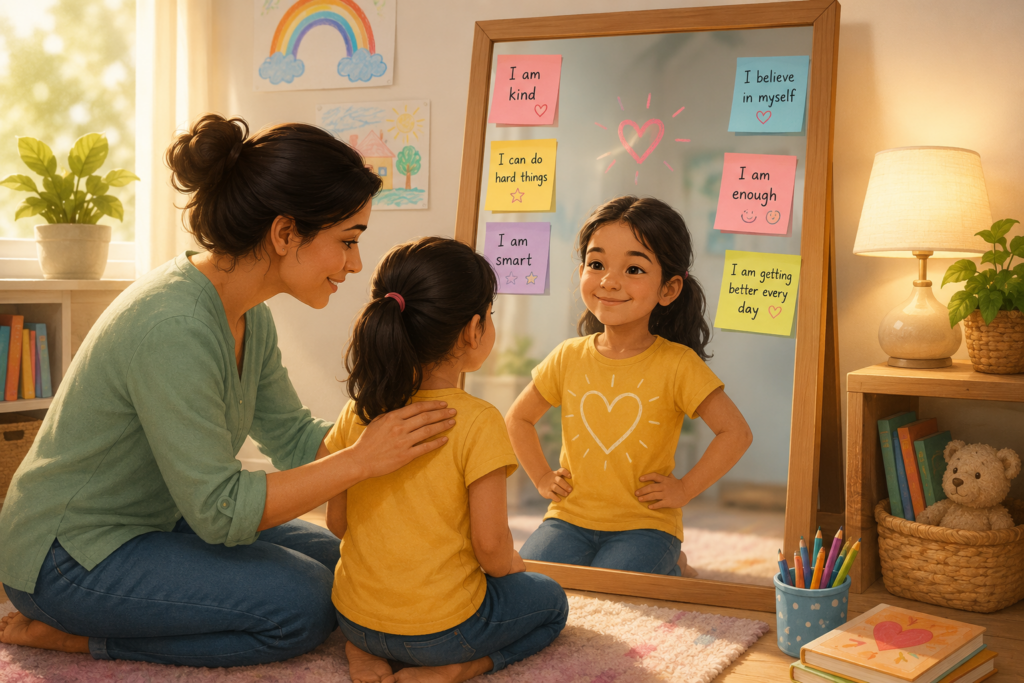
The night before Aarav's first school presentation, his mother Shalini found him sitting on his bed, staring at the wall.
He was seven years old. The presentation was three minutes long. And to Aarav, it felt like standing at the edge of the world.
"I can't do it," he told her quietly. "I'll mess up. I'm not good enough."
Shalini felt the familiar parental pull — to reassure immediately, to say "of course you can, you'll be wonderful," to smooth the fear away as quickly as possible. But something stopped her. She had been reading about mindful parenting, about the difference between dismissing a child's fears and actually helping them through it.
So instead of reassuring him, she sat beside him. She took a breath. And she asked: "Why do you feel that way? What makes you think you'll mess up?"
Aarav explained — haltingly, the way seven-year-olds do — that he was afraid of forgetting his words, of people laughing, of looking stupid in front of his class.
Shalini listened to every word. Then she said, gently: "What's one thing you could tell yourself that might help?"
Together, they worked through it. They took the thought "I can't do it" and slowly, carefully, replaced it with something truer: "I'll do my best, and it's okay if I make mistakes."
The next morning, Aarav stood at the front of his class. His hands were shaking. His voice wobbled on the first sentence. But somewhere in the middle of his presentation, his inner voice showed up — the one his mother had helped him build — and it said: it's okay. Keep going.
He kept going.
That evening, Shalini did not ask how the presentation went. She asked: "How did you feel when you kept going even though you were nervous?"
Aarav thought about it. Then he smiled. "Proud," he said.
That is what positive self-talk for kids looks like when it is built the right way. Not false confidence. Not empty reassurance. But a real, practised inner voice that tells a child the truth — that they are capable, that mistakes are survivable, and that trying matters more than being perfect.
Why the Voice Inside Your Child's Head Matters So Much
Every child has an inner voice. The question is not whether it exists — it is what it says.
For many children, that inner voice is harsh. Critical. Quick to catastrophize and slow to encourage. "I'm stupid." "I can't do anything right." "Everyone else is better than me." These thoughts do not always come from nowhere — they are often reflections of messages children have absorbed from their environment, their experiences, and sometimes from the adults around them.
The good news is that the inner voice is not fixed. It can be shaped, retrained, and redirected — especially in childhood, when the brain is at its most plastic and responsive. And the most powerful person in that process is a mindful parent who knows how to listen, how to ask the right questions, and how to model the kind of self-talk they want their child to internalize.
15 Mindful Parenting Tips to Build Positive Self-Talk in Kids
1. Model Positive Self-Talk Out Loud
Your child's inner voice is built, in large part, from yours. Children are listening even when you do not realise it — especially to how you talk to yourself.
When you make a mistake, say out loud: "That did not go the way I planned, but I can figure this out." When you face something difficult, let them hear you say: "This is hard, but I am going to keep trying." When you are nervous about something, model the reframe: "I am a little anxious, but that means I care — and that is okay."
These small, visible moments of self-compassion give your child a living example of what positive self-talk sounds like in real life — far more powerful than any lesson you could teach.
2. Teach Children to Recognise Negative Self-Talk
Before a child can change their inner voice, they need to be able to hear it. Many children are not aware that they are engaging in negative self-talk — it feels like truth rather than thought.
Help your child develop awareness by labelling it together. When they say "I'm terrible at maths," try: "That sounds like a negative thought. Is it completely true, or is it just how you're feeling right now?" Teach them the difference between a fact ("I got this question wrong") and a story ("I am bad at maths"). This distinction is one of the most valuable thinking tools you can give a growing mind.
3. Introduce Affirmations as a Daily Practice
Affirmations work — not as magic, but as repetition. The more a child hears and says something about themselves, the more it becomes part of how they see themselves.
Start simple. After a challenging moment, guide your child to say: "I am learning." "I am brave enough to try." "I am getting better every day." Put a few affirmations on a sticky note on their bedroom mirror. Read them together in the morning. Over weeks and months, these phrases become the automatic response to self-doubt rather than the harsh critic.
Choose affirmations that are truthful and specific rather than grandiose. "I am always perfect" is not believable and will not stick. "I try hard even when things are difficult" is true — and that truth is what gives it power.
4. Champion a Growth Mindset Over Perfectionism
One of the most damaging things a child can believe is that their abilities are fixed — that they are either good at something or they are not, and that failure proves the latter.
Counter this at every opportunity. When your child struggles, resist the urge to focus on the outcome. Instead, celebrate the process: "I am so proud of how hard you worked on that, even when it was frustrating." "Making mistakes is how our brains actually grow — did you know that?" "The fact that this is hard means you are learning something new."
Over time, this reframing builds a child who approaches challenges with curiosity rather than fear — who sees difficulty as evidence of growth rather than proof of inadequacy.
5. Reframe Challenges as Opportunities Together
When Aarav said he could not do his presentation, his mother did not tell him he was wrong. She helped him find a different way of looking at the same situation.
This is the art of reframing — and it is one of the most valuable tools in a mindful parent's repertoire. When your child says "this is too hard," try: "You have not figured it out yet — but you will." When they say "I always mess up," try: "You are still learning, and every try teaches you something." When they say "I am scared," try: "Being scared means you care. That is actually a good thing."
You are not dismissing their feelings. You are expanding the story they are telling themselves — making room for possibility alongside the difficulty.
6. Teach Self-Compassion as a Core Skill
Many children are kinder to their friends than they are to themselves. They would never say to a struggling classmate what they routinely say to themselves in the mirror.
Help your child notice this gap. "If your friend told you they were terrible at drawing, what would you say to them?" Let them answer. Then ask: "Can you say that to yourself?" Teach them that the same kindness and understanding they extend to others is something they deserve too.
Self-compassion is not self-indulgence. It is the foundation of emotional resilience — the ability to face mistakes and setbacks without being destroyed by them.
7. Create a Home Environment Filled With Positive Language
The words that fill a child's daily environment shape the words that fill their inner world. Be deliberate about the language your household uses — not just directed at your child, but around them.
Minimise criticism and complaint. Increase acknowledgment and encouragement. When something goes wrong, model the language of problem-solving rather than blame. "What can we do differently next time?" rather than "How did this happen again?" The emotional tone of your home is the water your child swims in every day — make it as nourishing as you can.
8. Focus Consistently on Strengths
Every child has strengths. Every child has areas where they struggle. A mindful parent knows both — and chooses, deliberately and consistently, to reflect the strengths back to their child.
When your child says "I am not good at drawing," you do not argue or dismiss. You say: "You are so creative — I love watching how your imagination works. And drawing is something that gets better with practice. You are already better than you were six months ago." This is not false praise. It is accurate, specific acknowledgment of what is real — combined with the truth that growth is always possible.
9. Teach the Power of "Yet"
This small word is one of the most transformative things you can introduce to a child's vocabulary.
"I can't do this" becomes "I can't do this yet." "I don't understand" becomes "I don't understand yet." "I'm not good at this" becomes "I'm not good at this yet."
The word "yet" does something remarkable — it takes a statement of apparent failure and turns it into a statement of trajectory. It tells a child that where they are right now is not where they will always be. That growth is not just possible but expected. Practice adding "yet" together whenever a negative self-talk statement comes up, until it becomes automatic.
10. Praise the Effort, Never Just the Outcome
"You are so smart" feels like a compliment. But research has shown repeatedly that outcome-based praise actually makes children less resilient — because it ties their self-worth to results rather than effort. When results disappoint, so does their sense of themselves.
Effort-based praise does the opposite. "I am proud of how hard you worked on that." "I love that you kept trying even when it was frustrating." "The fact that you did not give up is what matters most to me." This kind of recognition builds a child whose confidence is rooted in something they can control — their own persistence — rather than something as unpredictable as results.
11. Use Visual Reminders Around the Home
Children respond powerfully to their physical environment. A poster on the bedroom wall. A sticky note on the bathroom mirror. A small card in the school bag. These visual reminders of positive self-talk phrases create micro-moments of encouragement throughout the day — even when you are not there.
Let your child be involved in creating them. The affirmations they write themselves, in their own handwriting, decorated however they choose, carry far more weight than the ones a parent produces. Ownership deepens internalization.
12. Practice Mindful Breathing as an Anchor
When negative self-talk strikes — before a test, before a performance, during a conflict — the nervous system is activated and thinking becomes clouded. Teaching your child to breathe deliberately in those moments gives them a tool to create space between the thought and the reaction.
Practice together when things are calm. Breathe in slowly for four counts, hold for four, breathe out for four. Make it familiar, even playful. Then, when a difficult moment arrives and your child is spiraling, you can say: "Let's breathe first." That simple intervention can interrupt a negative self-talk spiral before it takes hold.
13. Make Positive Self-Talk a Family Habit
Like any habit, positive self-talk grows stronger with regular practice. Build it into your family's daily rhythm so that it feels natural rather than forced.
At dinner, share one thing each person is proud of themselves for that day — not an achievement, but an effort or a quality. Before bed, ask your child: "What is one kind thing you can say to yourself today?" These small rituals, repeated consistently, weave positive self-talk into the fabric of how your family thinks and communicates.
14. Be Patient With the Process
Changing an inner voice takes time. There will be days when all the work seems to have evaporated — when your child is back to "I can't," "I'm stupid," "I give up." This is normal. It is not failure. It is the non-linear reality of growth.
On those days, do not force it. Sit beside them the way Shalini sat beside Aarav. Listen. Ask one gentle question. Trust the process. The seeds you are planting are growing even when you cannot see them.
15. Celebrate Every Small Victory Along the Way
Aarav did not become a confident public speaker overnight. But on the day he kept going even though his voice was shaking — that was a victory worth celebrating. Not the perfect presentation. The decision to keep going.
Notice these moments. Name them. "Do you remember last year when you said you couldn't do it, and today you did? That was all you." Small victories, consistently acknowledged, build the evidence a child needs to believe in themselves. And that belief — built slowly, genuinely, over years of mindful parenting — is the most powerful thing you will ever give them.
The Voice That Stays
Aarav is ten now. He still gets nervous before presentations. He probably always will — most people do. But when the nerves come, there is a voice inside him that knows what to say.
I'll do my best. It's okay if I make mistakes. I've kept going before. I can keep going now.
That voice did not appear on its own. It was built — in a hundred small conversations, in a patient mother who asked questions instead of giving answers, in years of practicing positive self-talk for kids until it became second nature.
You are building that voice in your child right now. Every conversation. Every reframe. Every moment of genuine, specific encouragement. It is slow work. It is invisible work. But it is the work that lasts a lifetime.
Satyendra Kumar Singh is a Career Strategist, Corporate Trainer, and Mindful Parenting advocate with over 23 years of experience transforming lives through education and mentorship.