The morning Divya typed the last sentence of her memoir, she burst into tears.

Not from sadness — from relief. Eighteen months of writing. Three complete rewrites of the opening. Countless evenings at her desk when she would rather have been anywhere else. And now, finally: a completed first draft.

She sat back, breathed deeply, and then felt a new kind of panic arrive.

She had no idea what to do next.

The manuscript existed. But the book did not. And the distance between those two things — between a completed draft and a published, available, reader-reaching book — was a process she knew nothing about.

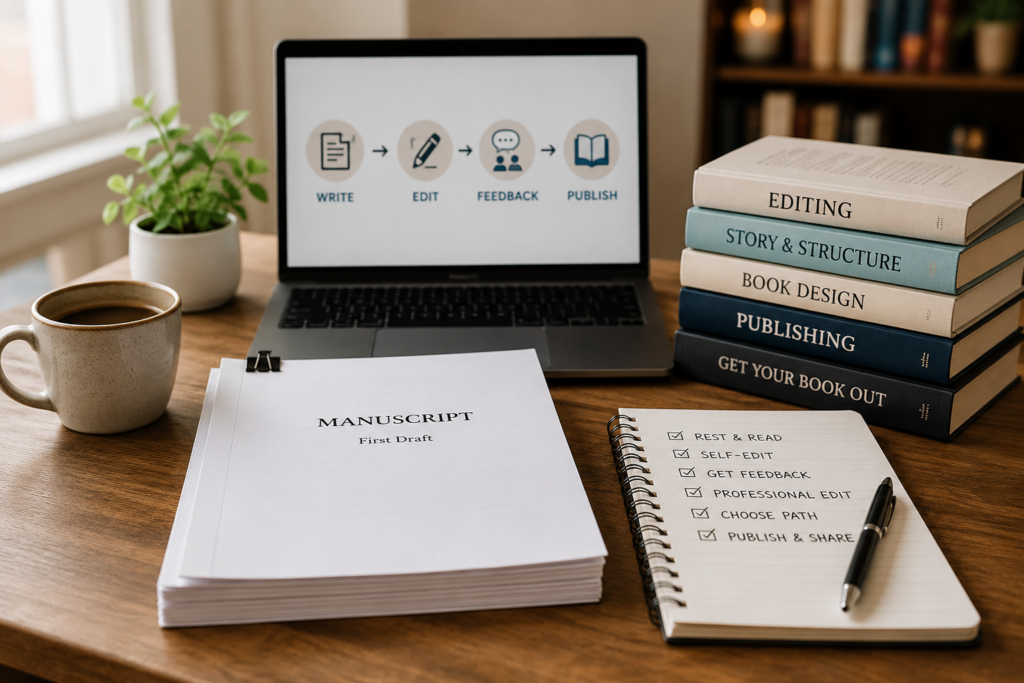
If you have finished your first draft and felt Divya's mixture of relief and disorientation, this guide is for you. It maps every step from completed manuscript to published book — in both traditional and self-publishing routes — with enough specificity to make each step navigable.

A Step-by-Step Guide for First-Time Authors  - From Manuscript to Published Book

Step 1: Rest. Then Read.

Before you do anything else with your completed manuscript, rest.

Put the draft away for a minimum of two weeks — ideally four. Work on something else. Read other books. Live your life. The goal is distance — because the manuscript you return to after several weeks of not reading it is the manuscript your reader will encounter, not the one you experienced while writing it.

When you return, read it all the way through — ideally in one or two sittings — without editing. Just read. Make notes as you go: the sections that feel strong, the sections that feel weak, the places where you lost interest or got confused, the structural questions that need answering. But do not edit. Not yet.

This first return read gives you the structural perspective that will guide your revision — the bird's eye view of what you have actually written, as distinct from what you intended to write.

Step 2: Self-Edit for Structure First

With your notes from the first read, address the structural issues before anything else.

Does the book have a clear beginning, middle, and end — and does each serve the purpose of that position in the journey? Is the sequence of chapters the most logical and effective one, or would resequencing improve the reader's experience? Are there chapters or sections that are redundant — making the same point twice, or developing material that does not serve the book's central purpose?

This is the most difficult part of self-editing — because it sometimes requires cutting material that you worked hard on and that you like. The test is not whether you like the material. It is whether the reader needs it. Material that does not serve the reader's journey through the book does not belong in the book, however much you love it.

Address structural issues first. Then, with the structure settled, revise at the chapter level — the argument or story within each chapter. Then at the sentence level. Always top-down, never bottom-up.

Step 3: Get Feedback From Trusted Readers

Before you invest in professional editing, share your revised manuscript with a small group of trusted readers — people who represent your target reader profile and who will give you honest, specific feedback rather than general encouragement.

Tell your readers specifically what you need: not "did you like it?" but "where did you get confused?", "where did you lose interest?", "what questions did the book leave unanswered?", and "what was the single most valuable thing it gave you?"

The feedback from thoughtful readers — even non-professional readers — consistently identifies the most significant remaining issues with a manuscript. It is also significantly cheaper than discovering those issues through professional editorial work on a draft that could have been improved first.

Step 4: Commission Professional Editorial Work

After your self-editing and trusted-reader revision, your manuscript is ready for professional editorial investment.

Begin with a structural assessment or developmental edit — the highest-level editorial work that evaluates the whole manuscript and identifies any remaining structural, argumentative, or narrative issues. If the developmental feedback is significant, revise before proceeding to lower-level editing.

Follow with line editing if your prose needs it, then copy editing, then proofreading at the formatting stage. Do not skip levels. Each level of editing prepares the manuscript for the next.

See the companion guide "Book Editing vs Proofreading: Understanding the Difference" for a detailed explanation of each editorial level and when it is needed.

Step 5: Choose Your Publishing Path

With a professionally edited manuscript in hand, you are ready to choose and pursue your publishing route.

The Traditional Publishing Route

Write your query materials.

For fiction, you need a query letter — a one-page professional letter that includes a brief synopsis, a description of the target reader, and a short author biography — and a synopsis of one to three pages that summarises the complete narrative arc.

For non-fiction, you typically need a book proposal — a document of twenty to fifty pages that includes an overview of the book's argument and structure, a sample chapter or two, a market analysis, a competitive title analysis, and an author platform statement.

These materials are often the most difficult writing a first-time author does — condensing a complex manuscript into a compelling, concise, professional pitch. Do not rush them. The query materials are your first — and sometimes only — impression on agents and publishers.

Research and approach agents or publishers.

If you are targeting the traditional publishing market, research agents who represent your genre and have a track record of placing books with publishers in your category. Platforms like QueryTracker, Manuscript Wishlist, and Publishers Marketplace (globally) and the Association of Authors' Agents (UK) list agents with their submission requirements.

In India, some publishers — particularly those in regional languages and certain non-fiction categories — accept direct submissions from authors. Research the submission requirements and guidelines of each target publisher carefully.

Submit and manage the waiting.

The submission and response process takes time. Query responses from agents typically take six to twelve weeks. Publisher responses can take three to six months or longer. It is normal — and expected — to submit to multiple agents simultaneously. It is less common to submit to multiple publishers simultaneously (agents typically manage publisher submissions sequentially or in focused batches).

Keep meticulous records of your submissions — who you submitted to, when, what you submitted, and the response (or lack thereof). Follow up professionally when the submission window has passed.

Negotiate your contract carefully.

If an agent offers representation, understand exactly what the representation relationship involves before signing. If a publisher makes an offer, understand every element of the contract — the advance, the royalty rates, the rights assigned, the territory, the publication timeline, and the reversion clause — before accepting.

Author contracts are complex. If possible, engage an agent (who will negotiate on your behalf) or an intellectual property lawyer who can review the contract. The contract you sign will govern your relationship with the publisher for the life of the book, possibly in perpetuity if there is no strong reversion clause. Understand it completely before signing.

The Self-Publishing Route

Invest in professional production

Self-publishing at a professional standard requires investment in three areas: editing (as described above), cover design (the most important marketing asset your book has — do not design your own cover unless you are a professional designer), and interior formatting (the typesetting of your text for print and digital formats).

These investments separate professional self-publishing from amateur self-publishing. Readers and reviewers judge books instantly by their covers and their interior design. A book that looks self-published in the pejorative sense — with an amateur cover, poor typography, and formatting issues — will be dismissed before it is read.

Set up your publishing infrastructure.

For digital publication, set up an account with Amazon Kindle Direct Publishing (KDP) for the global market, and platforms like Notion Press or Pothi for the Indian market. For print-on-demand physical copies, KDP Print and IngramSpark both provide access to global distribution networks.

Obtain an ISBN — International Standard Book Number — for each format of your book (e-book, paperback, hardback each require separate ISBNs). In India, ISBNs are assigned by the Raja Rammohun Roy National Agency for ISBN, which is part of the National Library of India.

Write compelling metadata.

Your book's title, subtitle, description, categories, and keywords are the metadata that determines how your book is discovered by potential readers on platforms like Amazon and Google. Invest time in crafting metadata that is both accurate and optimised for search — using the specific terms that your target readers are likely to use when searching for books like yours.

Price strategically.

Research comparable books in your genre and set your price competitively. For e-books, pricing between ₹100 and ₹300 is typically effective for Indian market authors building an audience. For print books, cover prices need to reflect production and shipping costs while remaining competitive with traditionally published alternatives.

Step 6: Build Your Author Platform and Marketing Strategy

Whether you are traditionally or self-published, marketing your book is your responsibility. Traditional publishers provide varying degrees of marketing support — typically more for established authors and high-advance books than for debut titles. Self-published authors are entirely responsible for their own marketing.

An author platform is the combination of your public presence, your audience, and your ability to reach potential readers directly. It includes your website, your social media presence, your email list, your speaking engagements, your media coverage, and your community relationships.

Building your platform should begin before your book is published — ideally six to twelve months before launch. Create content related to your book's themes. Build your social media presence on the platforms where your target readers are most active. Develop your email list — the most direct channel you have to people who have expressed interest in your work.

In the weeks around your launch, focus on visibility: media outreach (literary editors, book bloggers, podcasts in your topic area), launch events (virtual and physical), advance review copies to relevant reviewers and community leaders, and social media campaigns that engage your existing audience.

Step 7: Celebrate, Sustain, and Plan the Next Book

The launch week is not the end of your book's life. It is the beginning. Books build audience over time — through word of mouth, through ongoing media coverage, through the slow accumulation of reviews, and through the long tail of discoverability that search algorithms and recommendation systems provide.

Sustain your marketing beyond the launch week. Continue writing and sharing content related to your book's themes. Engage with readers who reach out. Apply to relevant awards — both for the recognition and for the visibility they generate.

And then, when you are ready — begin the next book. The second book is always easier than the first. The process is familiar. The publishing relationships are established. And you are a different writer for having completed the first — more skilled, more confident, and more capable of the sustained creative work that every book requires.

Divya's memoir was published fourteen months after that morning she sat at her desk in tears. She navigated every step in this guide — the self-editing, the developmental edit, the querying process, the contract negotiation, the launch. Each step was difficult. None was insurmountable.

"I wish someone had given me this map at the beginning," she told me. "I would have been less afraid."

Now you have it. The path from manuscript to published book is long, but it is navigable. Begin the next step.
Satyendra Kumar Singh is a Career Strategist, Corporate Trainer, and Literary Consultant with over 23 years of experience helping individuals tell their stories and share their expertise with the world.