When Suresh finished the manuscript for his first business book — a guide to building resilient supply chains in post-pandemic India — he knew it needed work before he could publish it. So he hired someone to "edit" it.

What he received back, three weeks later, was a manuscript with corrected grammar, fixed spelling, and improved punctuation throughout. The service was priced modestly. The work was technically competent.

But the book's core problem — a structure that buried the most important argument in chapter seven, when it needed to be the foundation of the whole book — was completely untouched. The chapters that were redundant with each other remained redundant. The sections where the author's expertise overwhelmed the reader's ability to follow were still overwhelming. The introduction that failed to establish why any reader should invest their time in the book was still failing.

Suresh had paid for proofreading and called it editing. The distinction between the two — and between the multiple levels of editing that professional publication requires — is one that every author needs to understand before they commission any work on their manuscript.

The Four Levels of the Editorial Process
Professional editorial services exist on a spectrum — from the highest-level work of restructuring and reconceptualising a manuscript to the finest-grained work of catching typographical errors in the final typeset. Each level serves a distinct purpose, and each is appropriate at a different stage of the manuscript's development.

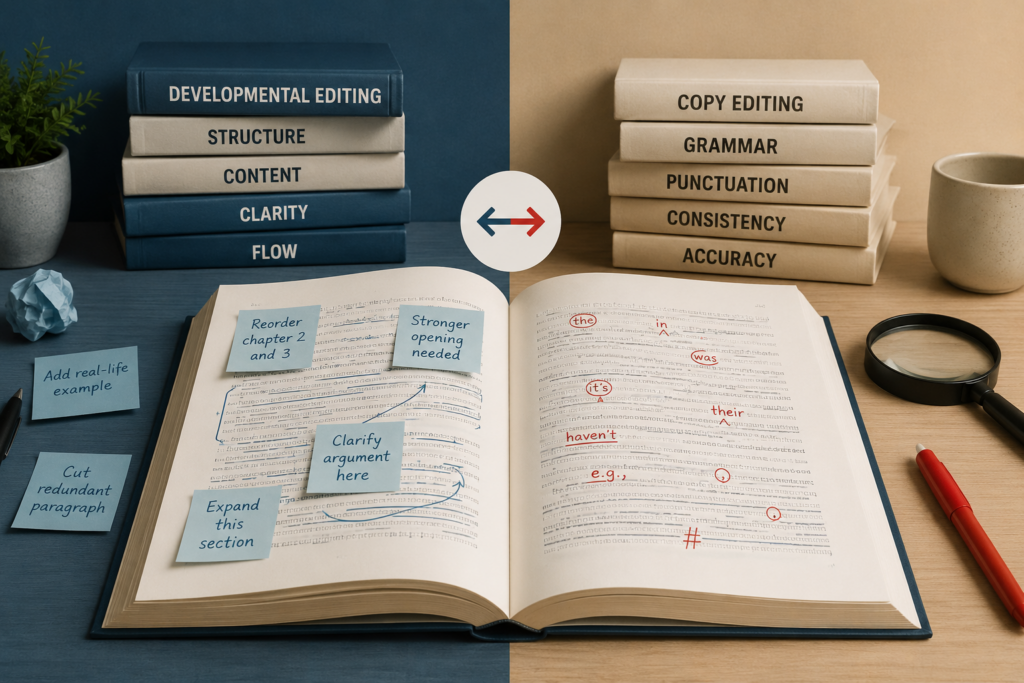
Level 1: Developmental Editing (Also Called Structural or Substantive Editing)

What it is : The highest-level and most transformative form of editing. A developmental editor evaluates the manuscript as a whole — the clarity and coherence of the central argument or story, the logical sequence of chapters, the development of ideas or characters across the full manuscript, the consistency of voice and perspective, and the overall effectiveness of the manuscript in serving its intended reader.

What it addresses : Structural problems — chapters that are missequenced, arguments that are unclear or underdeveloped, sections that are redundant, characters that are not working, arcs that are incomplete, narrative or argumentative logic that loses the reader.

What it does NOT address : Grammar, spelling, punctuation, or line-level prose quality.

When it is needed : Before other forms of editing. There is no point in polishing the language of a structurally flawed manuscript — it is like painting a house with a cracked foundation. Developmental editing comes first, because it shapes the manuscript that all subsequent editing will work on.

Output : Typically an editorial letter — a detailed written assessment of the manuscript's strengths and areas for development, with specific recommendations — plus an annotated manuscript.

Who needs it : First-time authors almost universally benefit from developmental editing. Experienced authors benefit from it when tackling a new genre, a particularly complex structure, or a project that has grown unwieldy. Authors who have been rejected by multiple publishers despite strong content often find that developmental editing reveals a structural issue they could not see themselves.

Level 2: Line Editing (Also Called Stylistic Editing)

What it is : A detailed edit at the level of individual paragraphs and sentences — improving the clarity, precision, flow, and impact of the prose without changing the substantive content.

What it addresses : Sentences that are awkward, unclear, or unnecessarily complex. Paragraphs that lose their thread or transition poorly. Passive constructions that weaken the prose. Jargon that alienates the reader. Redundancy within passages. Inconsistencies of tone or voice.

What it does NOT address : Structural issues (those belong at the developmental level) or typographical errors (those belong at the proofreading level).

When it is needed : After developmental editing, when the structure and content of the manuscript are settled and the focus moves to the quality of the prose.

Who needs it : Authors whose prose is functional but could be significantly more vivid, precise, or engaging. Subject-matter experts who know their field deeply but are not natural writers. Authors whose voice drifts inconsistently across a long manuscript.

Level 3: Copy Editing

What it is : A detailed technical edit addressing grammar, punctuation, spelling, consistency of terminology, factual accuracy, and adherence to a specified style guide (such as Chicago Manual of Style or the publisher's house style).

What it addresses : Grammatical errors. Spelling inconsistencies. Inconsistent use of terms (capitalisation, hyphenation, formatting of numbers and dates). Factual errors in dates, names, and specific claims. Departure from agreed style.

What it does NOT address : Structural issues, prose quality, or typographical errors introduced in the typesetting process (which comes after copy editing).

When it is needed : After line editing, when the prose is settled and the focus moves to technical correctness and consistency.

Who needs it : Every manuscript. Copy editing is a non-negotiable stage of professional publication. Even experienced writers make grammatical errors, use terminology inconsistently, and introduce factual inaccuracies. Copy editing catches these before publication.

Level 4: Proofreading

What it is : The final quality check before a manuscript is published — reviewing the typeset or formatted version of the manuscript for any remaining errors, including typographical errors introduced during typesetting, formatting inconsistencies, and any issues that previous editing stages missed.

What it addresses : Typographical errors (wrong letters, missing words, incorrect line breaks). Formatting inconsistencies (inconsistent heading styles, spacing anomalies, incorrect page numbers). Any residual errors from earlier editing stages.

What it does NOT address : Structural issues, prose quality, grammar (as a general matter — individual typos yes, general grammar no), or any substantive content issues.

When it is needed : After the manuscript has been typeset or formatted — as the very last step before publication. Proofreading a Word document before typesetting is useful but not a substitute for proofreading the typeset version, because typesetting introduces its own errors.

Who needs it : Every manuscript, without exception. No editing process — however thorough — eliminates every error. Proofreading is the final safety net.

The Common Confusion — and Why It Costs Authors

The most common and most costly confusion is between copy editing and proofreading on one hand, and developmental and line editing on the other.

Many authors — and some services that describe themselves as editing services — treat copy editing or proofreading as the entirety of the editorial process. The result is manuscripts that are technically correct but structurally flawed, that flow poorly, that fail to communicate their argument clearly, or that do not serve their intended reader effectively.

A manuscript that has been copy edited without being developmentally or line edited is like a house that has been cleaned without being repaired. It presents well at first glance. The underlying problems remain.

For Suresh's book, the correct sequence would have been developmental editing (to fix the structure), line editing (to improve the prose), copy editing (to ensure technical correctness), and proofreading (to catch final errors before publication). What he received — proofreading only — addressed the least important level of the editorial process while leaving the most important levels untouched.

How to Know Which Level Your Manuscript Needs

The answer depends on where your manuscript is in its development.

If you have a complete draft and you are uncertain whether the structure and argument are working : Start with developmental editing. Do not invest in line editing, copy editing, or proofreading until the structure is sound.

If the structure is solid but the prose is rough : Line editing.

If the prose and structure are both solid : Copy editing, then proofreading when you reach the formatting stage.

If you have a manuscript that has already been through developmental and line editing : Copy editing and proofreading.

Most first-time authors need to begin at the developmental level. Most authors who have been through previous publishing processes need at minimum copy editing and proofreading, and often benefit from line editing as well.

When in doubt, ask a developmental editor to assess your manuscript before you commission any editorial work. A brief assessment consultation will tell you which level is most appropriate for your specific manuscript — and save you the cost of investing in the wrong level at the wrong time.

What Suresh Did Next

When I explained the distinction to Suresh, he made an appointment with a developmental editor. Her assessment identified the structural issues that were preventing the book from working — and her detailed recommendations made the path to a restructured, stronger manuscript clear.

He revised the manuscript over three months. The developmental editor reviewed the revision. Then it went to a line editor. Then copy editing. Then proofreading on the final formatted version.

The book was published and received far better than its first draft would have warranted. The structure that had buried his most important argument now showcased it. The introduction that had failed to establish the book's relevance now drew the reader immediately into the problem the book existed to solve.

"I thought editing was one thing," he told me. "I didn't know there were four different things, each with a different job. If I had known that, I would have spent my money much more wisely at the start."

Now you know. Spend your money wisely from the start.
Satyendra Kumar Singh is a Career Strategist, Corporate Trainer, and Literary Consultant with over 23 years of experience helping individuals tell their stories and share their expertise with the world.